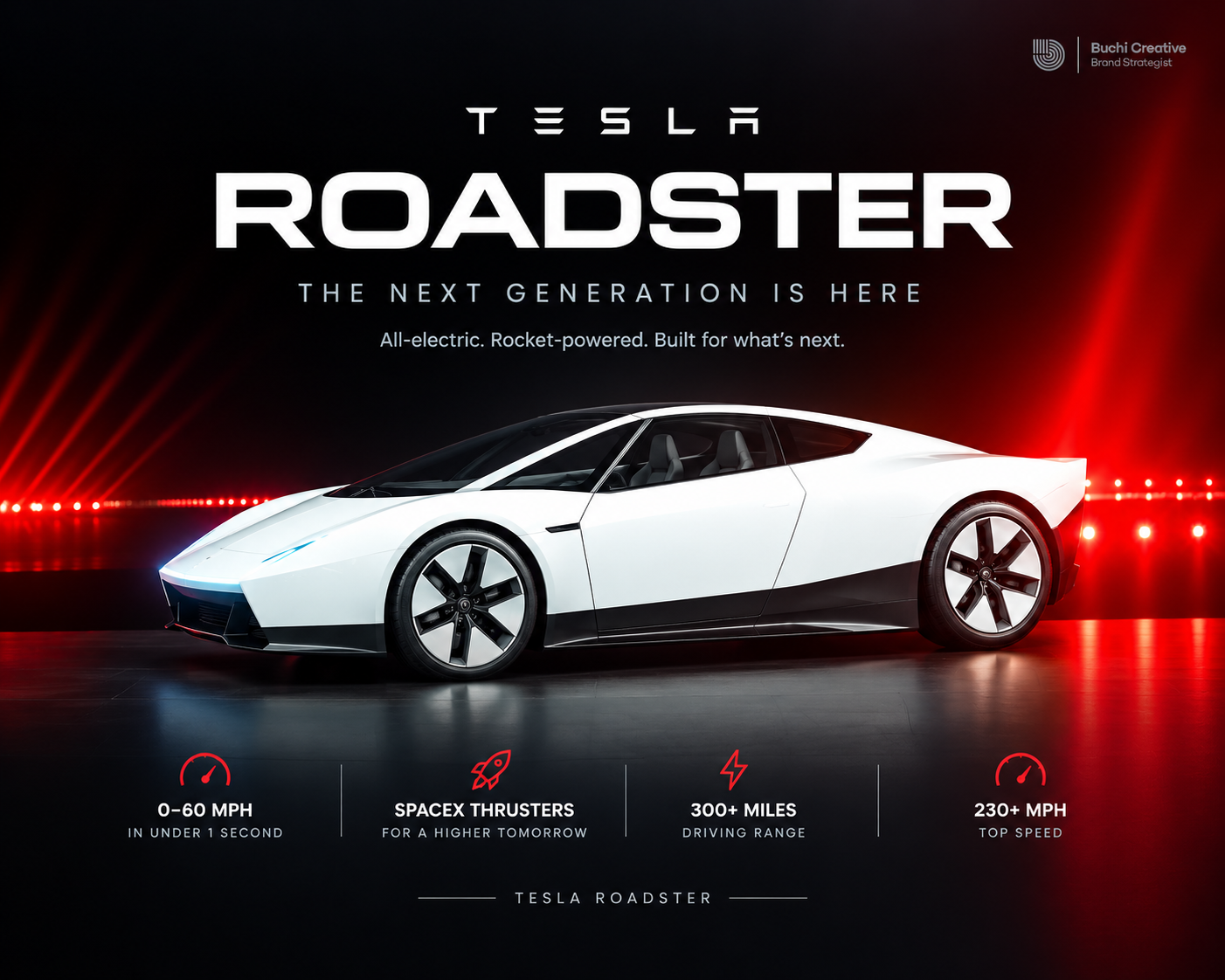
Tesla Roadster Flies in New Thruster Test: Inside Elon Musk’s Rocket-Powered Electric Car.
Tesla has unveiled a redesigned next-generation Roadster that can perform aerial manoeuvres using thrusters developed with SpaceX. The demonstration has reignited interest in the future of electric vehicles, rocket technology and high-performance sports cars.
Tesla has taken its long-awaited electric sports car in an extraordinary direction. On October 15, 2026, the company demonstrated its redesigned Tesla Roadster at an event held at a SpaceX test site in Texas, showcasing a vehicle that can lift off the ground, rotate in midair and land using built-in thrusters.
The demonstration marks a major moment for the second-generation Tesla Roadster, a project first announced in 2017. While the original concept promised extreme acceleration and sports-car performance, the latest version introduces rocket-inspired technology that could make it one of the most unusual electric cars ever demonstrated.
However, there is an important distinction: the demonstration took place under controlled conditions, and the Roadster is not yet a commercially available production vehicle.
What Happened During Tesla’s New Roadster Test?
The Tesla Roadster demonstration featured several manoeuvres that went beyond what people typically expect from an electric sports car.
According to reports from the unveiling, the vehicle drove up a specially constructed ramp, travelled upside down using a suction-based system, and performed aerial manoeuvres with assistance from its thrusters. In another demonstration, the car launched over a lineup of vehicles and rotated while airborne before returning to the ground.
These demonstrations were conducted at a controlled test facility rather than on a public road.
The footage attracted attention because it showed Tesla exploring a combination of electric vehicle engineering, aerodynamic systems and rocket-inspired propulsion technology.
For a company already known for its electric cars, the demonstration represents a different approach to performance engineering.
How Do the Tesla Roadster’s Rocket Thrusters Work?
One of the most interesting features of the new Tesla Roadster is its proposed SpaceX-inspired thruster system.
Elon Musk first discussed the possibility of adding rocket-style thrusters to the next-generation Roadster in 2018. The idea was to use the technology to improve acceleration, braking and cornering, with the possibility of enabling limited airborne manoeuvres.
The system demonstrated in 2026 uses compressed gas to generate thrust. Rather than functioning like conventional rocket engines that burn propellant, the reported cold-gas system releases stored pressurised air through specialised nozzles to produce force.
When gas is expelled in one direction, it generates a reaction force in the opposite direction. By controlling the direction and timing of the thrust, the system can influence the vehicle's movement and orientation.
SpaceX has experience with cold-gas propulsion systems used for spacecraft control. Applying related technology to a car presents a different engineering challenge, particularly when managing weight, stability, pressure, control and safety.
The Roadster demonstration suggests that Tesla and SpaceX engineers have explored ways to apply this technology to a high-performance vehicle. However, the system's full capabilities, practical limitations and long-term reliability will require further verification.
Tesla Roadster Performance: How Fast Is It?
The next-generation Tesla Roadster has been promoted as an exceptionally fast electric sports car.
During the October 2026 unveiling, Tesla representatives described performance figures that included acceleration from zero to 60 miles per hour in less than one second, a top speed exceeding 230 mph, and a driving range of more than 300 miles. These figures are manufacturer-reported claims and should not be confused with independently verified, real-world test results.
Here are the key specifications reported during the unveiling:
- Vehicle type : All-electric sports car
- Seating : Two seats in the standard configuration
- Acceleration : 0–60 mph in under one second, as claimed
- Top speed : More than 230 mph, as claimed
- Driving range : More than 300 miles, as reported
- Thruster technology : SpaceX-inspired compressed-gas propulsion
- Expected production : 2028
- Availability : Not yet commercially available
The specifications may change before production begins. Tesla has not yet established a full set of independently verified production specifications for the vehicle.
Is the Tesla Roadster Actually a Flying Car?
The short answer is that the demonstration showed the Roadster performing airborne manoeuvres, but that does not automatically make it a practical flying car.
A conventional car relies on its tyres, suspension and road contact to move. An aircraft, on the other hand, is designed to generate and manage lift while maintaining controlled flight.
The Roadster's demonstrated manoeuvres rely on specialised thrusters and other systems rather than the conventional aerodynamic lift associated with an aeroplane.
This distinction matters because a short, controlled jump is not the same as sustained flight. A production vehicle would also need to address stability, emergency control, landing, passenger protection and applicable transport regulations.
Tesla has not demonstrated that the Roadster can function as an ordinary aircraft or travel freely through the air like a helicopter.
For now, the most accurate description is an electric sports car demonstrated with rocket-inspired propulsion and experimental airborne capabilities.
The Role of SpaceX in Tesla’s Roadster Project
Tesla and SpaceX are separate companies led by Elon Musk, but their engineering ambitions sometimes overlap.
Tesla focuses on electric vehicles, energy storage and related technologies, while SpaceX develops launch vehicles, spacecraft and other spaceflight systems.
The Roadster's thruster concept illustrates how technology associated with aerospace engineering might be adapted for a high-performance road vehicle.
However, integrating rocket-inspired systems into a car involves challenges that do not necessarily arise in the same way in spacecraft. Engineers must consider vehicle mass, energy requirements, control systems, component durability, operating conditions and the safety of people nearby.
The new Roadster also serves as a technology showcase for Tesla, demonstrating its ambitions beyond conventional electric vehicle performance.
Whether the thruster system will be practical for everyday driving remains an open question.
Why Has the New Tesla Roadster Taken So Long?
Tesla first unveiled the second-generation Roadster in November 2017, presenting it as a major step forward for electric sports cars. At the time, deliveries were anticipated to begin in 2020.
The project subsequently experienced multiple delays as Tesla concentrated on other vehicles and manufacturing priorities.
The October 2026 unveiling therefore represents a significant milestone after years of waiting. Nevertheless, unveiling and demonstrating a vehicle are not the same as beginning mass production.
Tesla has indicated that production is expected to begin in 2028. That timeline leaves important questions about final specifications, pricing, regulatory compliance and customer deliveries.
Until production vehicles are completed and delivered, the Roadster's ultimate performance and availability remain subject to change.
How Much Will the Tesla Roadster Cost?
Tesla has not confirmed a final retail price for the redesigned Roadster.
Reports following the unveiling indicated that the company presented different configurations, including a Performance version, a Thrust version featuring acceleration thrusters, and an invite-only Rocket configuration described as having a full flight system.
The reported reservation deposits were $50,000 for the Performance version and $250,000 for the Thrust version. These are reservation amounts, not confirmed final purchase prices.
The proposed Rocket configuration is described as a single-seat model. Its final pricing and availability remain unclear.
Given the vehicle's specialised engineering and positioning as a high-performance electric sports car, the Roadster is aimed at a very different market from Tesla's mass-market vehicles.
Potential buyers should consult Tesla's official website for the latest availability, reservation terms and specifications before making any financial commitment.
##What the Tesla Roadster Demonstration Means for the Future of Electric Cars
The new Tesla Roadster raises an interesting question about the future of automotive engineering: how far can manufacturers push the limits of a vehicle designed primarily for road use?
Electric motors have already changed expectations around acceleration and power delivery. Advances in batteries, software, power electronics and vehicle control have also created new opportunities for automotive designers.
The Roadster adds another idea to that conversation by exploring compressed-gas thrusters and other experimental systems.
However, extraordinary demonstrations do not automatically translate into practical consumer technology. Cost, reliability, safety, maintenance and regulation will determine whether such systems can become viable beyond specialised vehicles.
The more immediate significance may be what the project reveals about the intersection of electric vehicle engineering and aerospace technology.
For Tesla, the Roadster is both a high-performance vehicle and a showcase of its engineering ambitions. For the automotive industry, it is another example of how manufacturers are exploring technologies that would have seemed unusual in a conventional production car.
Finally, Tesla's redesigned Roadster has attracted attention for a reason. Its combination of electric propulsion, extreme performance claims and SpaceX-inspired thrusters takes the idea of a sports car beyond the conventional boundaries of automotive design.
The October 2026 demonstration showed that the project has progressed beyond the concept originally presented in 2017. But the most important test is still ahead: turning the demonstration vehicle into a production car that can meet real-world expectations for performance, reliability and safety.
With production expected in 2028, the coming years will determine whether the Tesla Roadster becomes a genuine milestone in electric vehicle engineering or remains primarily a technology showcase.
One thing is certain: Tesla has given the world a new reason to watch the future of electric sports cars.